
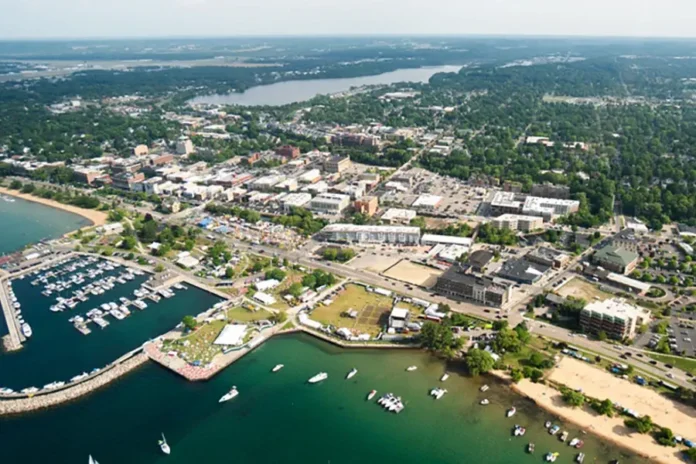
A great lake day rarely lives up to the fantasy. You picture slow mornings on the dock and golden evenings by the water — and then you spend half the trip circling for parking, paying to leave the car somewhere, and shuttling between a hotel on one side of town and a restaurant on the other.
It doesn’t have to go that way. The United States has somewhere north of 100,000 lakes, and a handful of the towns built along them were laid out long before cars dictated everything. In these places, the dock, the dinner, the morning coffee, and the bed you sleep in are all close enough to handle on foot. You arrive, you park once (or never), and the car stops being part of the vacation.
To put this list together, I leaned on three things: a town’s Walk Score — the widely used 0-to-100 measure of how much daily life you can do without driving — its setting right on the water, and the kind of traveler chatter that tells you whether a place feels walkable in practice, not just on paper. Here are five that earn it.
Ithaca, New York — the one that’s basically built for this
If any town on this list was designed to make you forget your car keys, it’s Ithaca. Sitting at the foot of Cayuga Lake in the Finger Lakes, it posts a Walk Score in the low 90s — high enough to land in the rare “Walker’s Paradise” tier, the same bracket as dense city neighborhoods.
The reason is the core. Downtown centers on the Ithaca Commons, a pedestrian-only stretch of a few blocks where cars simply aren’t a factor — just restaurants, independent shops, music spilling out of doorways, and a steady rotation of festivals and street performers. Two campuses, Cornell and Ithaca College, keep the energy young and the calendar full.
The recognition isn’t just local pride, either. Ithaca has been singled out nationally as one of the best places in the country to live without a car, and it’s shown up on “best town to visit” lists in recent years. Add waterfalls and gorges within reach of the center, and you’ve got a place where the car can stay parked the entire trip.
Car-free tip: Ithaca is reachable by intercity bus from New York City and other regional hubs, which means you can skip the rental entirely and walk straight into the heart of town.
Chelan, Washington — fjord scenery, a 20-minute town
Lake Chelan is a showoff. Carved by glaciers over 10,000 years ago, it’s the deepest lake in Washington and one of the deepest in the entire country, plunging close to 1,500 feet. It’s also long and narrow — more than 50 miles of water threading between forested mountains at the edge of the North Cascades, with the look of a fjord.
The town of Chelan anchors the lake’s southern tip. Off-season it’s a quiet community of a few thousand; in summer it balloons past 25,000 as visitors pour in. Over the past decade it’s also grown into a legitimate wine country stop, with the restaurants and tasting rooms to match.
Getting there is the one catch — it’s a 200-plus-mile drive from Seattle, so this isn’t a no-car-at-all destination. But once you’re in town, you’re set. A Walk Score in the high 70s puts it firmly in “Very Walkable” territory, and most of what you came for — shops, food, the waterfront — sits within a 20-minute stroll.
Car-free tip: Build your stay around a lakeside hotel and you can leave the car parked from check-in to checkout.
Traverse City, Michigan — the foodie pick on Lake Michigan
Traverse City is the largest town in northern Michigan, and it’s spent the last several years quietly turning into one of the Midwest’s best eating destinations — the kind of place that lands on national “best dining” roundups. The good news for non-drivers: most of that scene is packed into a compact, very walkable downtown that scores in the mid-80s on Walk Score.
What makes Traverse City special is how easily the outdoors plugs into the walkable core. The TART Trail, a paved path running more than 10 miles, links the city to neighboring communities and lets you cover real ground on foot or by bike. A state park puts sandy Lake Michigan beaches within reach, and a nearby nature preserve threads trails through old orchards and woods.
Car-free tip: Pick lodging near the bottom of the bay and you can chain together breakfast, beach, trail, and dinner without ever touching a steering wheel.
Sandpoint, Idaho — small, remote, and surprisingly strollable
Sandpoint sits on Lake Pend Oreille in Idaho’s panhandle, ringed by mountains and home to only about 11,000 people. It’s earned the nickname “Aspen of the panhandle” for its scenery — without the price tag or the crowds.
Yes, it’s out there: roughly seven hours from Boise and five and a half from Seattle. But the town itself was built tight, wedged between the slopes and the shoreline, which is exactly why it walks so well — a Walk Score around 85 despite its small size. The downtown stacks shops, restaurants, and culture into a few easy blocks, anchored by the Panida Theater, a 1920s movie house that still runs films and live shows today.
Car-free tip: Sandpoint sits on a long-distance rail line, so for the right itinerary you can roll into town by train and explore the whole place on foot.
Wolfeboro, New Hampshire — New England’s original lake resort
Wolfeboro bills itself as “America’s oldest summer resort,” and it wears the history well. Perched on Lake Winnipesaukee with just over 2,000 year-round residents, it’s the smallest town on this list and the coziest — a classic New England main street that fills out with visitors every summer.
Its Walk Score sits in the low 70s, enough for “Very Walkable,” and the scale does most of the work: the historic downtown, the inns, and the waterfront are all close together. When you want to stretch your legs, the Cotton Valley Rail Trail follows an old railroad bed out of town, crossing causeways over neighboring ponds and lakes. Cap a day with dinner at one of the town’s well-regarded restaurants and you’ve got a near-perfect car-free weekend.
Car-free tip: Wolfeboro is small enough that a single centrally located inn puts essentially everything within walking distance.
How to plan a genuinely car-free lake trip
A high Walk Score gets you halfway. The other half is how you book it. A few things that make the difference between “walkable in theory” and “I never started the car”:
- Sleep in the center. The single biggest factor is where you stay. A lakeside or downtown room turns the whole trip walkable; a motel on the highway undoes a perfect Walk Score instantly.
- Check how you arrive. Ithaca (bus) and Sandpoint (train) can be reached without a car at all. Chelan, Traverse City, and Wolfeboro are easier with one to get there — so the move is to drive in, park, and not touch it again.
- Cluster your plans. Pick a town where the food, the water, and a trail or two all sit near each other, and the car becomes dead weight.
The payoff is simple: more time actually by the lake, and a lot less of it spent looking for somewhere to park.
Walk Score ratings referenced here reflect publicly reported figures and can shift over time; it’s worth checking current scores and seasonal transit schedules before you book.