
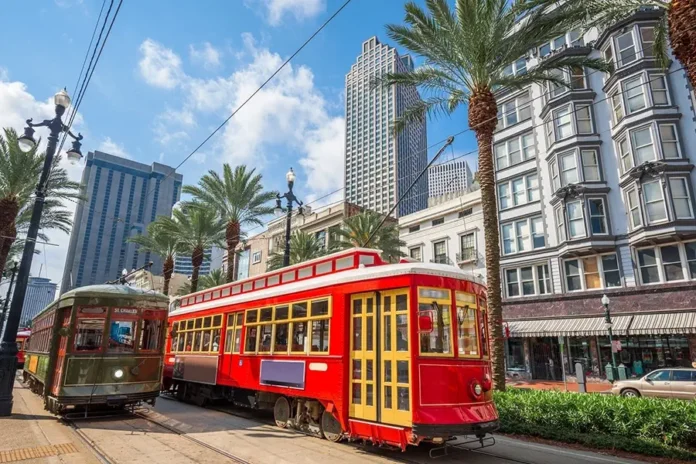
For years, the great train trips of the world meant Europe’s high-speed corridors, Japan’s bullet trains, or the sleeper routes threading across China. American rail rarely entered the conversation. That’s quietly changing.
Amtrak carried roughly 34.5 million passengers in its 2025 fiscal year, with ticket revenue climbing more than 10 percent over the prior year. New lines are opening, dormant routes are being revived, and private operators are pouring billions into tracks and stations. The result is a genuinely different map than the one travelers knew even three years ago.
Here are five routes — a mix of brand-new launches, expansions, and long-awaited comebacks — that are pulling riders back onto the rails.
1. The Borealis: A Faster Link Between Chicago and the Twin Cities
Since its 2024 debut, the Borealis has become one of Amtrak’s quiet success stories. It connects Chicago to Minneapolis–St. Paul, and it hit 250,000 riders just over a year after launching — well ahead of projections.
The Borealis doesn’t replace the long-haul Empire Builder (Chicago to Seattle and Portland) or the busy Hiawatha shuttle to Milwaukee. Instead, it adds frequency and flexibility for a corridor that needed it.
What makes it worth the seat:
- A beer-and-history stop in Milwaukee. The city’s brewing heritage, planted by 19th-century German immigrants, still defines its character.
- An arts-heavy finish in the Twin Cities. The Walker Art Center and its open-air sculpture garden — home to the photogenic Spoonbridge and Cherry — anchor a city that also gave the world Prince. Music fans can trace his legacy to First Avenue, while theater lovers head for the Guthrie.
This is a route built for weekenders and culture-seekers rather than thrill-chasers, and that’s exactly why it works.
2. Canyon Spirit: A Luxury Run Through Red-Rock Country
If your priority is scenery, this is the headliner. The Canyon Spirit — the rebranded name for the U.S. service formerly known as Rocky Mountaineer — runs entirely in daylight so passengers never miss a mile of the landscape through its glass-dome coaches.
The big news for 2026: the route now stretches all the way to Salt Lake City. Beginning April 21, 2026, a new three-day itinerary links Denver and Salt Lake City, with overnight stops in Glenwood Springs, Colorado (famous for its mineral hot springs) and Moab, Utah (the gateway to Arches and Canyonlands). The original two-day Denver–Moab journey still runs alongside it.
The trip traces the Colorado River through rugged canyons, crosses the Continental Divide, and rolls across Utah’s high desert before the Wasatch Mountains rise into view near Salt Lake City. It follows a corridor first carved by the Denver & Rio Grande Western Railroad in the 1870s to haul coal and timber — track built for industry, now repurposed for the view.
A heads-up for budgeting: this is a premium experience, not a commuter fare. The three-day Salt Lake City journey starts around $2,123 per person plus tax, with hotel nights included. There are no sleeper cars; the model is daylight travel paired with off-train stays.
3. The Floridian: Chicago to Miami Without Changing Trains
Introduced in 2024, the Floridian stitched together two existing services — the Capitol Limited (Chicago to Washington, D.C.) and the Silver Star (formerly New York to Miami) — into a single one-seat ride between the Midwest and South Florida.
The catch is the commitment: roughly 46 stops and about 47 hours end to end. This is a route for travelers who treat the journey as the point, not for anyone in a hurry.
It’s also temporary by design. Once New York’s East River Tunnel rehabilitation wraps up — expected in 2027 — the two original services are slated to split back apart. Until then, the Floridian is the only way to ride straight from Chicago to Miami without switching trains.
4. Brightline: America’s Private High-Speed Bet
Brightline is the country’s only privately owned intercity passenger railroad, and it leans hard into the experience. The line connects Miami and Orlando, two of Florida’s busiest destinations, with an extension to Tampa in the works.
The amenities are a deliberate contrast to the no-frills reputation of American rail: high-speed Wi-Fi, roomy seating, sleekly designed stations, and even a signature citrus scent piped through its terminals. The seats are reportedly trimmed in the same leather used in Bentley cars.
The company’s ambitions stretch well past Florida. Brightline West, a true high-speed line connecting Rancho Cucamonga, California (about 40 miles east of downtown Los Angeles) to Las Vegas, is under construction and targeted to open around 2029. If it delivers on its promised speeds, it would be the closest thing the U.S. has to a European or Asian bullet-train corridor.
5. The Mardi Gras Service: A Gulf Coast Comeback 20 Years in the Making
The most emotionally resonant entry on this list is a revival. The Mardi Gras Service, launched August 18, 2025, restored passenger rail between New Orleans and Mobile, Alabama — a connection severed when Hurricane Katrina wrecked the Gulf Coast tracks in 2005.
For nearly two decades, freight trains rolled along the corridor while passengers were left without service. The new line runs two daily round trips over a roughly 145-mile coastal route, stopping in Bay St. Louis, Gulfport, Biloxi, and Pascagoula, Mississippi. The full trip takes about three hours and 43 minutes.
Riders showed up immediately — inaugural tickets sold out within a day, and the route has stayed strong even on traditionally slow midweek days, helped along by New Orleans Saints fans riding to games.
There’s a fitting symmetry to the two endpoints. New Orleans throws the nation’s largest Mardi Gras celebration, but Mobile’s Carnival tradition is actually the older of the two, dating to 1703.
Where This Is All Headed
The American rail network is still a work in progress next to the systems abroad. But the direction is clear: record ridership, multi-billion-dollar private investment, revived routes, and new corridors connecting cities that haven’t had a direct link in years — or ever.
The appeal underneath all of it is simple and a little old-fashioned. Train travel trades speed for space — room to work, read, or just watch the country slide past the window. For a growing number of travelers, that trade is starting to look like the better deal.
Fares, schedules, and launch dates are subject to change. Check the operator’s official site before booking.